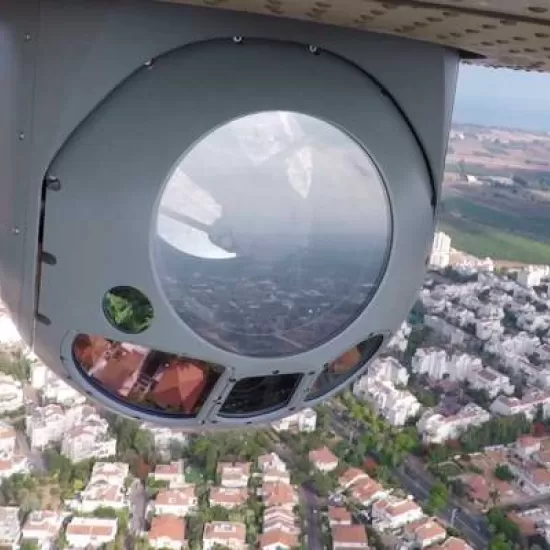


SPECTRO: The Payload That Lets You See Beyond
The ground troops were deep inside enemy territory, the icy rivers and snowcapped mountains along the frontier made the operation tougher than they had prepared for. They were on a covert mission to destroy hostile positions and needed heavy air support to get to their end point.
Several kilometers away a helicopter awaited the green light from the unit commander to rise above the snow-covered cliffside where he had been waiting, concealed. And then it came, the commander radioed in the coordinates of an apartment where a sniper was concealed in a cave.
It took only a few seconds for the pilot to target the cave and designate it for the fighter pilot who moments later fired his munition to the target that was marked with a laser. The threat posed by the sniper was gone, and the ground troops were clear to move on to their target several meters away.
The whole operation took just a few moments, thanks to Elbit Systems' Spectro™ XR multi-spectral electro-optical payload that was mounted on the helicopter.
The Spectro™ XR payload provides continuous target scanning capabilities for enhanced situational awareness and is designed for day-and-night and all weather extended-range surveillance.
Helicopters are clear targets for enemies who have shoulder launched surface-to-air missiles, so "in order to stay covert and increase survivability, helicopters need to stay away from the line of fire," said Yossi, Senior Director, Head of EO Business Unit.
And once they are in the air, the "helicopter crew has to quickly gather intelligence and analyze all the data," Yossi continued, adding that "the data needs to be precise in order to avoid civilian casualties."
The long-range multi-spectral electro-optical ISTAR solution has cutting-edge performance in the 15" category payloads, multispectral optics including large 7" common aperture-almost twice the average diameter for this category. The Spectro™ XR spotter is based on the core technology of the company's space cameras.
Because not only does Elbit Systems produce and manufacture groundbreaking solutions here on earth, but the company has for over 30 years been a leader in the development and production of complex space cameras and telescopes.
"The Spectro™ XR has the best optics possible for pilots," Yossi said. "Because in optics, size does matter." the bigger the optics, the higher the resolution. And that allows for better Detection, Recognition and Identification.
Multi-spectral imaging spotter telescope combines multiple optical channels (VIS, MWIR, and SWIR) into one. The Spectro™ XR can precisely detect, identify and mark targets that are over 20 kilometers away- providing outstanding range performance without increasing size and weight.
Spectro™ XR is equipped with a wide range of digital imaging, high-definition sensors, advanced lasers and overlay features, including image blending, tracker, geo-pointing, scanning and target acquisition, with a high level of stabilization. With sophisticated AI and algorithms, the solution allows for high probability of detection with minimum false alarms, intelligence gathering and targeting in real time.
It can be integrated onto attack or utility helicopters to carry out both land and naval missions. Yossi explained that there is also a need for maritime helicopters to be equipped with optical payloads with unique spectral signature recognition technology as introduced by the Spectro™ XR CU for search and rescue missions.
And according to Yossi, many militaries are in the process of converting utility helicopters to attack helicopters.
"It's something that started during the COVID-19 pandemic and has seemed to increase during the war in Ukraine" he explained. "During the pandemic defense budgets were cut so militaries decided to upgrade their platforms. With the outbreak of the war in Ukraine we understood from militaries that they needed much more."
Under these circumstances, the Spectro XR is the optical payload of choice.
FAQ
How do helicopters find and identify targets from long distances?
Advanced electro-optical systems use high-resolution sensors, multi-spectral imaging, and long-range optics to detect, recognize, and identify targets from extended distances.
What is multi-spectral imaging and how does it improve target detection?
Multi-spectral imaging combines visible, infrared, and additional spectral bands to reveal targets and details that may be difficult to detect with conventional sensors.
How are targets designated for precision strikes?
Targeting systems use laser designation, tracking technologies, and real-time intelligence to accurately mark targets for precision-guided weapons.
How do military aircraft conduct surveillance at night and in bad weather?
Electro-optical and infrared sensors enable crews to detect, track, and identify targets in darkness, adverse weather, and complex operational environments.
Important Notice: Certain blog articles may contain forward-looking statements and are not intended to provide business, financial, or investment information. Please review our full disclaimer here.