

When the Real Mission Feels Familiar
At Nevatim’s C-130 simulation center, aircrews rehearse demanding mission phases long before takeoff, entering real operations with the precision of practiced experience.
Modern tactical airlift missions place some of the highest demands on military aviation. Whether performing low-altitude cargo drops in challenging terrain or executing emergency procedures that require split-second precision, crews must achieve full operational readiness long before they enter an actual aircraft.
At Nevatim Airbase, the Israeli Air Force has built a training environment designed specifically for this challenge: a state-of-the-art center anchored by two advanced full-mission simulators, the “Samson” simulator for the C-130J Super Hercules and the “Karnaf” simulator for the C-130H Hercules.
These simulators form the core of the IAF’s tactical airlift training program. They replicate real-world flight conditions with high fidelity, providing safe and repeatable environments where crews can rehearse complex and high-risk scenarios. Their introduction has influenced the IAF’s training methodology, aiming to ensure that aircrews reach the runway already prepared for the mission ahead.
Built Through Crisis
The development process underscored the program’s complexity. Yosef, a former IAF aircrew member and long-time Elbit Systems project manager, guided the creation of the Samson and Karnaf simulators from their earliest stages.
The contract, initiated between 2019 and 2020, immediately encountered the full impact of the global pandemic. Much of the system was first built in the United States before being transferred to Israel – a logistical sequence complicated by travel restrictions, supply-chain delays, and remote integration efforts carried out across continents.
Despite these obstacles, the project advanced steadily. By July 2023, the IAF began operational use of the simulators, and the training center quickly became a critical asset. Although tactical transport represents a relatively small segment within Elbit, the Samson and Karnaf programs – together with additional training solutions for the IAF’s Beechcraft King Air (Zofit) fleet – form a comprehensive, IAF-dedicated training ecosystem at the national level.
Full-Mission Capability
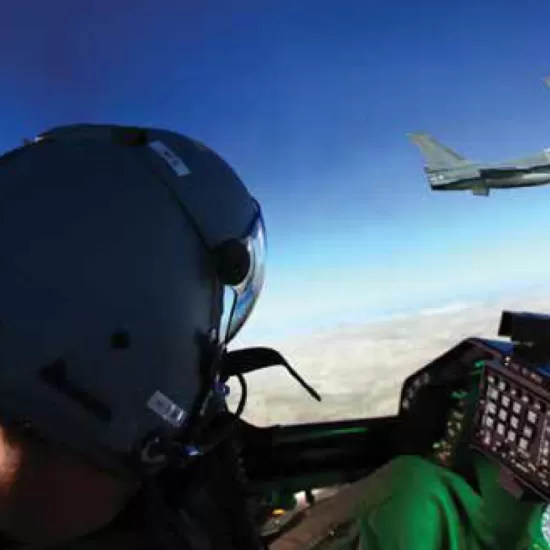
What distinguishes these simulators is their ability to deliver a full mission envelope rather than only routine flight instruction. Crews rehearse the full range of operational scenarios they may later encounter: low-level navigation over mountainous terrain, formation flight, nighttime operations with night-vision systems, aerial-refueling procedures, and landings on rough or unpaved strips.
Yosef describes scenarios in which pilots can feel the vibration of gravel during touchdown or experience the turbulence of desert winds with a level of realism comparable to actual flight. The system simulates threats such as incoming missiles and anti-aircraft fire, and it models the thermal properties of terrain for electro-optical and infrared sensors.
High-Fidelity Simulation at Every Level
To achieve this level of realism, the system integrates several advanced technologies. A high-resolution visual display, built from a network of projectors and mirrors, creates a wide and immersive field of view.
The underlying terrain database integrates satellite imagery, elevation models, and highly accurate thermal and physical attributes. This enables the simulators to generate realistic day- and night-time environments, EO and IR representations, and detailed three-dimensional models of buildings, antennas, and ground infrastructure.
The motion platform adds another layer of fidelity. Pilots feel the aircraft respond to weather, turbulence, and ground conditions. A detailed flight model, refined to stringent IAF requirements, aims to ensure that control inputs behave exactly as they would in the real Samson or Karnaf.
The simulators also support large crews. Up to ten personnel can train simultaneously, including pilots, flight engineers, and loadmasters. Long-duration missions can be rehearsed with crew swaps, and the Karnaf’s capability to refuel two helicopters in parallel is fully modeled.
Simulating the Untrainable
One of the center’s key strengths is its ability to recreate emergencies that cannot be practiced in real aircraft. Engine failures during low-altitude drops, electrical malfunctions, hydraulic issues, terrain-avoidance events, or complex multi-system failures can be triggered repeatedly until crews internalize the correct responses.
The result is instinctive, confident performance under real-world pressure. Emergencies that would be too hazardous to simulate in flight become essential and routine parts of the training cycle.
A Cooperative Effort
The project reflects a collaboration between Elbit Systems, Lockheed Martin, CAE and additional partners, combining international experience with Elbit’s expertise in avionics and advanced training systems. Elbit teams contributed to system development and remained embedded at Nevatim Airbase, supporting maintenance activities and instructing operational procedures alongside IAF personnel.
The IAF’s tactical airlift squadrons now rely on the Samson and Karnaf simulators as an integral element of their mission-preparation cycle. The training center provides an environment where crews can practice, refine, and validate the full mission scope without ever leaving the ground. The result is a force that arrives in the cockpit already synchronized, already experienced, and already prepared for the most complex tasks modern airlift demands.