

Small Deck, Long Reach
As maritime arenas become larger, busier, and harder to secure, Elbit Systems is exploring a different kind of long reach: compact unmanned aircraft launched not from a billion-dollar aircraft carrier but from converted vessels designed to carry persistent intelligence far from shore.
A border that looks manageable on a map can become a vast operational puzzle once it stretches across open water, island chains, trade routes, or remote economic zones. A patrol ship can see only so far. A helicopter launched from it can extend that picture, but not for long enough, and small VTOL drones can help the vessel crews look beyond the horizon, though their endurance and payload capacity may remain very limited.
For countries that need to monitor vast maritime spaces without building or acquiring full aircraft carrier capabilities, the question becomes straightforward: how can a naval force extend its reach without turning itself into a superpower navy?
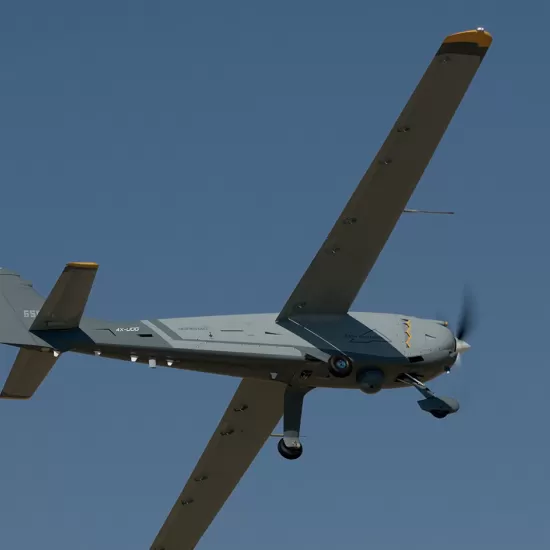
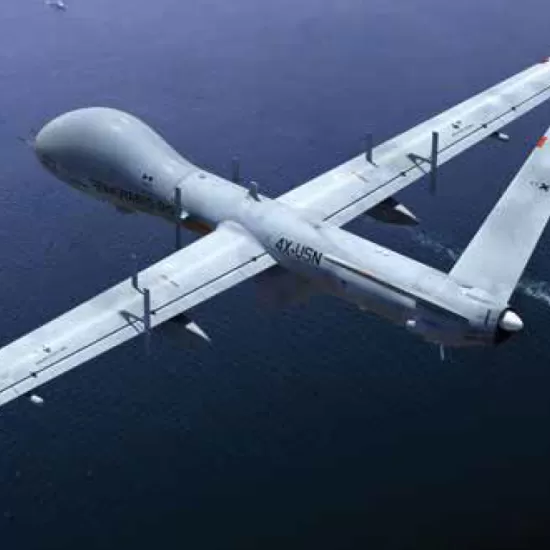
This is one of the ideas behind the Hermes™ 650 Spark Maritime Apparatus. The Hermes™ 650 was designed around a set of deliberate choices: a powerful front-mounted engine, short takeoff and landing capability (STOL), 2 large and capable payload bays, satellite communications, advanced diagnostic systems, and compatibility with existing Hermes 900 ground control infrastructure. In other words, it is not simply another aircraft in the Hermes family but a system built around enhanced operational flexibility.
A Different Engine, A Different Envelope
Many unmanned aircraft are built with rear-mounted engines. The Hermes™ 650 Spark takes a different approach. Elbit chose a front-mounted engine configuration to give the aircraft greater power margins, meaning a wider speed envelope and enough power to support demanding mission profiles, heavier payloads, and short-runway operations. The design enables STOL (short takeoff and landing) capability, allowing the aircraft to operate from runways far shorter than those normally associated with larger unmanned systems.
For Elbit, this opens a maritime concept in which a commercial ship is converted to carry multiple Hermes 650 Spark aircraft, each capable of flying long missions far from the vessel and returning after many hours in the air, using the aircraft as an airborne extension of the ship’s operational reach.
From Merchant Vessel to a Drone Ship
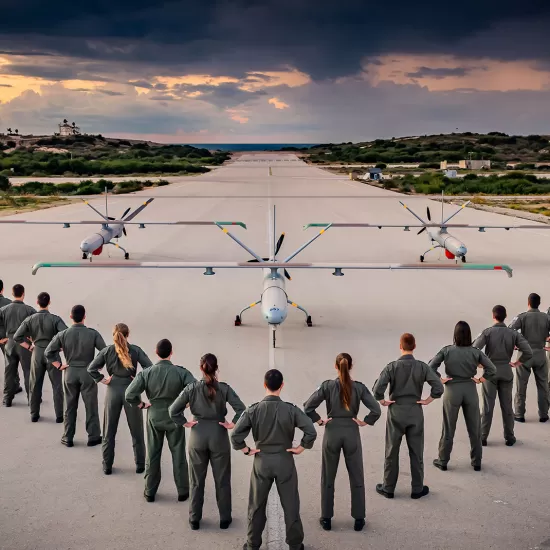
The more unusual part of the concept is not the aircraft but the vessel around it. Elbit’s idea is to offer customers a turnkey solution in which a standard commercial ship can be converted into a dedicated unmanned aviation platform. Instead of purchasing a traditional aircraft carrier or relying solely on naval helicopters, a customer could operate a vessel carrying several Hermes 650 Spark aircraft, around 9 to 12 platforms, with deck infrastructure, control systems, and mission support built around the UAS.
This turns the ship into something closer to a floating remote aerial base. It can move through maritime arenas carrying unmanned aircraft that extend its operational picture and attack capabilities well beyond the range of onboard sensors and weapons. The goal is not to imitate a U.S.-style aircraft carrier, with its enormous cost and strategic complexity, but to create a leaner and more accessible form of maritime airpower.
A Long Arm for Large Maritime Spaces
Today, many ships carry helicopters or small drones. Both are useful, but each has limitations. Helicopters are expensive to operate and depend heavily on crew, maintenance, and weather conditions. Small VTOL drones are easier to deploy, but they usually offer shorter range, shorter endurance, and smaller payload capacity. The Hermes 650 Spark is intended to occupy a different space: small enough to operate from a compact maritime setup, but capable enough to fly long-range missions and remain airborne for hours.
This has obvious relevance for countries with extensive maritime responsibilities. Japan, for example, faces a vast maritime geography to its east and west. Denmark must consider Greenland, where distance is not a detail but a defining operational challenge. Germany’s security environment in the Baltic Sea has also become more complex in recent years. For such countries, the need is not only to defend a coastline but also to maintain awareness across large, distant, and sometimes difficult maritime spaces.
One Control Station, More Choices
For customers already operating the Hermes 900, the ability to operate a mixed fleet and fly the Hermes 650 Spark from the same ground control environment is valuable. It means that the aircraft can be integrated into an existing operational ecosystem rather than requiring a completely separate infrastructure, training model, or command setup. In practice, this also helps to enable flexible operational concepts in which the Hermes 650 can be managed as part of a combined array alongside the Hermes 900 from a land-based control system, while retaining the option to deploy it to a vessel when needed. In such cases, the ship serves as a remote launch and recovery site, whereas mission control can remain distributed between the land-based array and onboard ship systems. This approach helps to reduce manpower requirements, lower the need for additional control stations, and enhance overall operational efficiency, particularly in maritime environments where space and resources are limited.
A New Kind of Maritime Presence
The result is neither a traditional naval aviation model nor the small-drone model that has become familiar on ships in recent years. It is something in between: a cost-effective floating base built around unmanned aircraft.
As maritime security becomes less about a single coastline and more about large, shifting areas of interest, this kind of solution may become increasingly relevant. Not every country can operate an aircraft carrier, and not every mission requires one. But many countries need a longer reach at sea.
FAQ
What is a vessel-based UAS operation?
A vessel-based UAS operation uses ships as launch and recovery platforms for unmanned aircraft, enabling long-range intelligence, surveillance, and reconnaissance missions far from shore.
How does Hermes™ 650 support maritime operations?
Hermes™ 650 provides persistent airborne coverage, long-range ISR capabilities, satellite communications, and flexible deployment options for monitoring large maritime areas.
How can navies extend maritime surveillance beyond the horizon?
Navies can extend maritime surveillance by deploying long-endurance unmanned aircraft from maritime platforms, increasing coverage beyond the range of onboard sensors and traditional ship-based observation systems.
Can commercial vessels be converted into drone carriers?
Yes. Commercial vessels can be adapted to support unmanned aircraft operations, including launch, recovery, mission planning, and operational support functions.
Why are unmanned aircraft becoming important for maritime security?
Unmanned aircraft provide persistent coverage, long-range intelligence gathering, and operational flexibility, helping naval forces monitor large maritime areas more efficiently and at lower cost than traditional alternatives.