

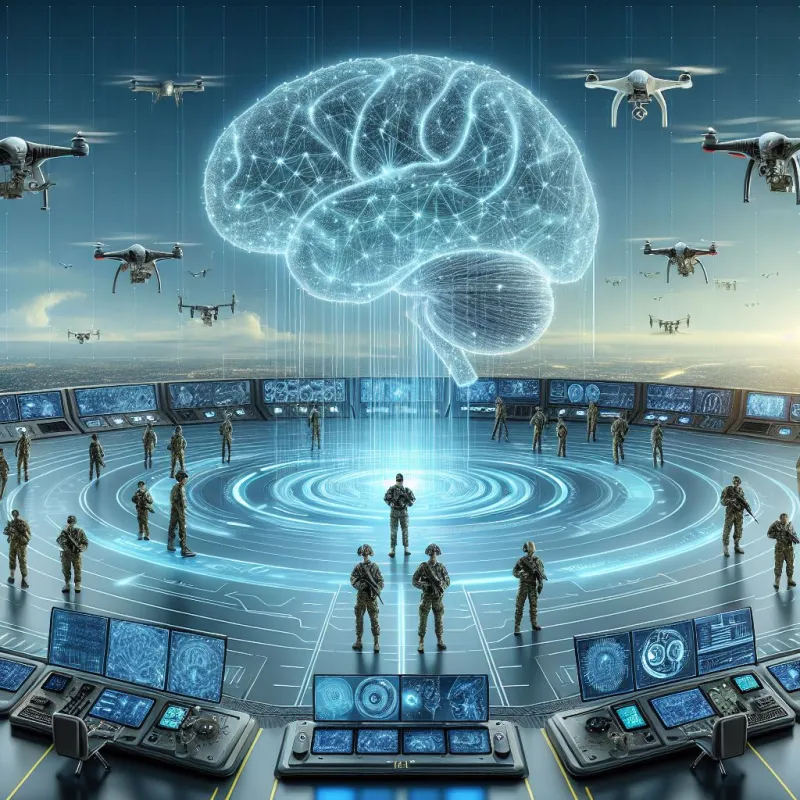
How AI Is Changing the Defense Landscape
Artificial Intelligence is Helping to Reshape the World and Transforming the Future of Defense. Leveraging AI for strategic superiority, Elbit Systems is integrating advanced technologies for enhanced military capabilities.
The world is increasingly dominated by Artificial Intelligence and the defense industry is posed for unprecedented opportunities. AI is helping to reshape the future of the defense landscape through efficient, accurate weaponry and providing strategic advantages on the battlefield and beyond.
Designed to mimic human intelligence, AI can be programmed to do various functions such as learn, reason, solve problems, perceive and even interpret language and sentiment. Divided into the main subsets of machine learning, deep learning and Generative AI, AI-powered analytics can predict and analyze quicker and more accurately than humans.
AI’s potential in defense is vast. It can streamline operations, enhance decision-making capabilities, increase the accuracy and lethality of warfighters and autonomous platforms can even help take the soldier out of the minefield.
And as the importance of AI in the future of defense and national security continues to grow, according to a recent report by Precedence Research, the global AI market in aerospace and defense is set to surge from some USD $28 billion today to USD $65 billion by 2034. While North America currently leads the AI market, as the US government and military are investing highly in AI (some $1.8 billion in AI and machine learning capabilities alone in 2024) and demanding the presence of AI on government contracts, Europe is not far behind.
Before ChatGPT and OpenAI
The United States Department of Defense have been investing in AI and fielding data- and AI-enabled systems for over decades since funding for the first academic AI research hubs in the 1960s. Since then, investment in AI has led to it becoming an important aspect of military operations, where it has increased the efficiency and precision of warfighters.
"Reality moves so fast, and these capabilities are changing the way data is stored and how we look for it. It effects defense because in the past, technology was developed for defense and then incorporated into the civilian world, but now in some cases it’s the opposite," said Assistant Professor Dr. Oren Gal, Swarms and AI Lab SAIL, at that University of Haifa.
"There is an increasing investment in defense technology due to the increase in the defense budgets," Gal said, adding that AI is having an impact on the civilian world and that these sorts of technologies are also in already changing conceptions and the way of thinking in defense industries.
According to Eli Friedman, VP Innovation at Elbit Systems, while AI was already being incorporated into defense technology for decades, the real AI revolution began in 2017.
"Companies at the intersection of AI and defense, like Palantir and Anduril, are positioning themselves as important partners in defense. Meanwhile, defense-tech startups are aiming for disrupting traditional military procurement by using simple designs in a large quantity," Friedman said.
"The key is finding the correct model in which both the corporate world and the startups collaborate in such a way that each brings their strengths to the table and together they give much more value to the customers as well as to the shareholders. Elbit is an innovator in these aspects too," Friedman added.
In early March the United States Department of Defense's Defense Innovation Unit (DIU) awarded a contract to Scale AI and Anduril for an AI system dubbed Thunderforge to "accelerate decision-making, allowing planners to more rapidly synthesize vast amounts of information, generate multiple courses of action, and conduct AI-powered wargaming to anticipate and respond to evolving threats," according to a statement made by the DIU on March 5, 2025. "Thunderforge marks a decisive shift toward AI-powered, data-driven warfare, ensuring that U.S. forces can anticipate and respond to threats with speed and precision," the DIU added.
Agreeing with Friedman, Gal proposed that the DNA of defense companies and government bodies that handle the field "should be adjusted so they can understand what the technologies are and the specialists in these fields are usually not in government but in civilian industries."
"We need to adapt our systems to new threats, and so we need to invest in that. We all understand that the field of defense, and our private lives, is not the way we thought it would be because of the data revolution," he said.
"I believe AI is the future," said Professor Irad Ben-Gal (PhD) is the head of the Laboratory for AI, Machine learning, Business and Data Analytics (LAMBDA) at Tel Aviv University.
Calling the advancement of AI "unprecedented," Ben-Gal compared the changes that it could bring to the Industrial Revolution.
"We are only at the beginning, and we may see a variety of advancements in many different directions. And like many other innovations-like fire, the wheel and writing-when you control a new power where you can propose new solutions, on the other hand it comes with new risks."
A Digital Disruption
As the AI revolution continues at full speed, the defense industry and governments are attempting to understand, test and adopt AI capabilities to determine where they will be best used.
As a high-tech defense company, Elbit Systems works with the Israel Defense Forces and the Directorate of Defense Research and Development (DDR&D), at Israel's Ministry of Defense, and has been putting in considerable efforts for integrating AI technology into its platforms and solutions across its division and subsidiaries. The tools are either developed in-house or commercially purchased and then incorporated into the company's solutions.
Friedman explained that the company's CEO Bezhalel (Butzi) Machlis believes that AI tools may be used to not only be more efficient but also to assist the company in achieving a competitive edge with its products and solutions.
A New Era
"This is a new era of AI," said Omer, Director of Big Data and AI at Elbit Systems.
"We are lowering the barrier to use the technology for multiple domains. Elbit Systems has been working with AI for close to two decades including building in-house innovative enterprise unstructured data backbone for AI development. Now the company is leveraging AI across multiple domains, including employer productivity, operational productivity, engineering productivity and more."
According to Omer, "Elbit took the strategic decision to migrate to Microsoft's cloud" three years ago. "Now," he said," Elbit can consume those state-of-the-art technologies in an easy and secure way."
Omer, who leads Elbit in the fields of AI and GenAI, has been in the field for the past 15 years.
"AI isn’t just a buzzword, it’s a culture and we are in the process of adjusting our ways of working to make us more productive," Omer said.
AI, he explained, brings us a new level of reasoning and increases productivity and efficiency in large corporations like Elbit which has thousands of workers across the world.
"If we can make our employees or machines more productive, then we can execute and deliver more," he said, adding that "To be relevant and survive on market, enterprises must adopt, embed and leverage AI, across the organization."
According to Ofer, VP, Generative AI Hub at Elbit's C4I & Cyber Division, the biggest advancement in AI in terms of performance is coding and daily mundane tasks, meanwhile, the biggest adoption of AI is in software development.
Elbit Systems, he said, has adopted deep learning in many of its systems.
"In engineering, we are embracing AI and are trying to increase its adoption. And while AI is believed to be magical, it's not magical in the workplace just yet. There's still a long way to go before it replaces workers," he said.
"So far, we aren't seeing AI replacing humans, but it helps in making them more productive," said Ofer. "We won't be eliminating the tank commander; we are making him more efficient. AI cannot eliminate soldiers in the field, we are not close to that day where we replace them."
"How do you explain the geo-spatial situation of the battlefield? You sense, smell and feel the world. Humans can have a sixth sense about what's going on, so how do you explain that to a model," he asked.
Though AI is in use in a variety of applications, "one of the biggest changes has been in autonomy that has truly changed how things are working-drones, missiles, unmanned platforms (maritime and aerial). These capabilities, autonomous decision-making capabilities have changed the rules of the game," Gal said.
Next Is Now
The impact of Elbit's advanced technology, with AI and Generative AI integrated within the company's solutions and products have already been proven on modern day battlefields, where it allowed commanders to make critical real-time decisions during combat.
"In the C4I & Cyber division we use programs where we get insights from the data to predict the next step of the battle," said Friedman. "The systems thinks."
What used to take days, now takes hours. From network combat systems, unmanned platforms, border security solutions, Helmet Display and Tracking System (HDTS) and more- Elbit Systems has a wide portfolio of products that use scalable toolboxes of AI and machine learning decision support algorithms.
"The company's arsenal of rockets and missiles also use AI in the sensors to help identify targets from non-combatant infrastructure and individuals," Friedman said.
"Some of our missiles use electro-optic (EO) sensors where it can differentiate between a car or tree in order to distinguish between what is a target and what is not a target. It’s a major issue in intelligence gathering and distinguishing between enemy and non-belligerent," he explained.
As one of the pioneers in the field of Electronic Warfare (EW), Elbit Systems develops, manufactures, and supplies comprehensive solutions in the electromagnetic spectrum, including complete EW Suites, Spectrum Control, Communications and Signal Intelligence. EW is used in both offensive and defensive missions to obtain a strategic edge. AI is used to enhance signal processing and threat detection capabilities while machine learning algorithms analyze the electromagnetic spectrum to provide more effective jamming power against the enemy.
The company's use of AI, in the air, sea or on the ground, provide warfighters with critical targeting information improving mission outcomes as well as survivability.
The First Digital War
While AI has been used in military contexts before, the scale and integration of AI technologies in the "Swords of Iron" War are unprecedented, making it a meaningful milestone in the history of AI in warfare. From unmanned aerial systems and drones to electronic warfare (EW), intelligence gathering, robotics and more, AI played an important role in various aspects of the war.
"When the war (with Hamas) began, AI was widely used in weapons and Elbit is leading some of these directions like autonomous vehicles, different platforms and weapons that are targeted and analyzed constantly with AI, drones, AI on a strategic level to analyze different signals that can show how the enemy is working (including in civilian areas),
In addition to the weaponry, Ben-Gal said that the use of AI for psychological warfare "was also evident" with both sides using GenAI to generate messaging, deep fakes and more for social media campaigns on both sides "aimed at harming social structure and stability."
It's Not Perfect
But there is also an array of concerns as governments and non-state actors compete for leadership in this emerging domain that still lacks global governance guidelines. Such technology, while it presents historic opportunities to improve defense and security, hostile actors can also use AI to improve their methods and lethality.
According to Ben-Gal, "one of the risks, like all revolutions, is the increase of the gap between individuals and countries that can use/have access to the new technology and those who are left behind. It's unfair by definition and it creates a lot of tension and unrest. We will see several countries and companies that will lead this revolution and will make them competitive and will lead to unrest and instabilities with other countries or companies."
World powers such the United States, Russia and China, already locked in decades-old geopolitical battles, are also competing to be the champion of military AI.
There are numerous ethical considerations that also need to be considered when integrating AI into the battlefield, including the over reliance on technology that may lead to a degradation of skills, potential errors in target identification, cyber security risks and more.
When discussing enterprise AI, risks can be great. Because like anything that has to do with accessing networks, the burning concern is how to secure the connection and avoid a hostile actor from placing malicious code?
According to Omer, "we need to choose the right tools and technology so that they benefit us and don't expose us to cyber risks or expose us to legal issues concerning intellectual property."
Unauthorized access to data used can lead to data breaches and privacy violations, Omer explained, adding that GenAI models can be susceptible to attacks, such as prompt injection, where malicious inputs manipulate the model to produce harmful outputs.
In addition, using unlicensed content data can lead to copyright violations.
"Determining who owns the rights to content generated by AI is complex and legal guidelines are constantly evolving," Omer said.
For Ofer, one needs to "use AI responsibly and with caution." Adding that we still to "test and make sure that it is not operating in a way that is malicious or harms the system that it is embedded in."
Ben-Gal pointed out that "there are certain industries such as service companies where AI can be relatively easily implemented." He stated that healthcare is one area where such technology is being integrated. Meanwhile, there are strict regulations in other areas, such as banking or the prison system.
"You cannot talk about AI without talking about regulation," he continued, pointing to the General Data Protection Regulation (GDPR) and California's SB 896: Generative Artificial Intelligence Accountability Act.
"There are standards that regulate AI, and one of the main ideas is to be sure that the systems are unbiased since AI can be easily biased because it has relatively no limitations," he said.
"The idea of morality and self-awareness and understanding are heavy questions that are very challenging to answer," Ben-Gal said.