

Countering the Drone Threat, Everywhere
How a 360° Counter-UAS concept extends protection from the individual soldier across the entire operational space.
Small drones have altered the geometry of the battlefield. What began as a localized air-defense challenge has evolved into a persistent, low-altitude, multi-domain threat, shadowing forces from fixed bases to convoys, from dismounted patrols to covert operations.
At the recent Counter UAS (C-UAS) Technology Show, Elbit Systems returned for a second consecutive year with a clear message: counter-UAS can no longer be addressed as a point solution. It must be holistic and continuous.
"In today’s battlefield, low-cost drones and FPV kamikaze systems appear suddenly and in large numbers, making portable C-UAS systems essential for survival". Says Y, head of Land EW BD, ISTAR & EW Division at Elbit Systems.
"The ability to provide every squad or platoon leader an immediate counter drone capability fundamentally changes the balance. When soldiers can detect, disrupt, and defeat drones within seconds using gear they already carry, fully aligned with the same logic used in mounted and mobile C UAS systems, we shift from reactive defense to a unified, proactive protection layer across all mobility and platforms levels.”
T, Senior Director of Business Development at Elbit Systems ISTAR & EW with responsibility for the U.S. market, adds: “From a market perspective, we see growing demand for solutions that are not only technologically advanced, but also operationally coherent. Customers are looking for integrated concepts they can deploy and dismount quickly, adapt across platforms, and sustain over time.”
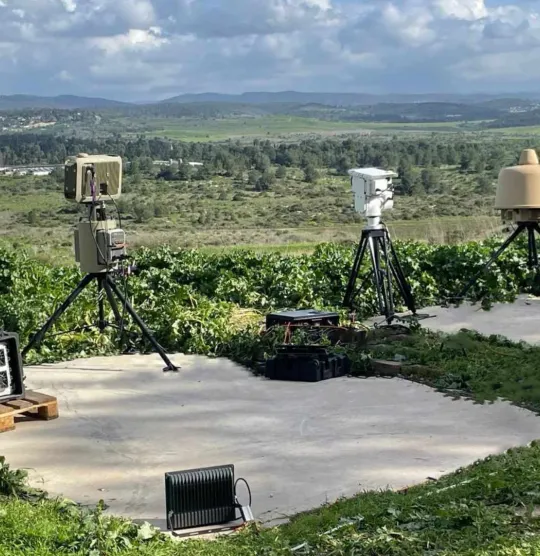
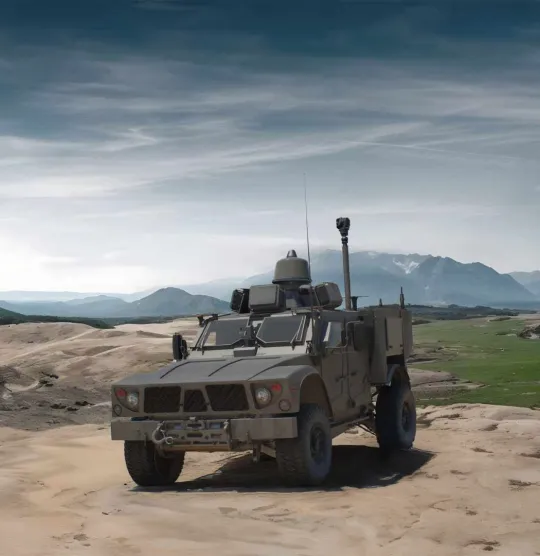
That requirement for continuity sits at the core of what Elbit defines as Protection 360° (or Protection 24/7): a modular counter-UAS approach designed to support forces throughout their operational scenarios. From deployed positions on land and where relevant, at sea, to a soldier carrying a backpack-mounted capability, through protected mobility inside vehicles, the same layered logic applies.
From Detection to Effect
At the system level, the architecture is deliberately multi-disciplinary and modular. Threats can be detected through advanced SIGINT, radar, electro-optical, or acoustic sensors, depending on the operational context. Once identified, commanders can select non-kinetic soft-kill effectors to limit collateral impact, or escalate to additional interception methods, including drone-on-drone options, as well as hard-kill effectors when required.
The emphasis is not on using any single sensor or effector, but on orchestration: timely detection, informed response selection, and uninterrupted protection.
This layered continuity is what differentiates the concept at the operational level. Rather than deploying separate systems for bases, vehicles, and infantry, the same modular building blocks scale from battalion level down to the individual soldier.
Officials attending the show, many shaped by recent operational lessons from the wars in Ukraine and Israel, described a consistent gap in current inventories: organic counter-UAS protection that follows forces across air, land, and sea, regardless of platform or mission profile. According to Elbit’s team, the interest stemmed from the recognition that this gap could be addressed through a single, coherent framework.
Mobility as a Design Principle
At the exhibition, mobility was treated as an important design requirement, not an afterthought. Modern forces rarely remain static, and protection must move with them. Elbit’s display reflected that reality, combining representative models of armored platforms, dismounted soldier systems, SIGINT and jamming equipment to illustrate how the same protection logic adapts across different operational contexts.
The objective was not to showcase a standalone product, but to demonstrate how different elements interlock into a single, coherent operational concept.
This is also where the “one-stop-shop” idea becomes practical rather than rhetorical. By integrating sensors, command-and-control, and effectors under a single operational framework, continuity becomes not only technological, but also operational and logistical, helping to simplify and streamline deployment, training, and sustainment.
A Changing U.S. Context
The relevance of this approach is reinforced by recent structural changes in the U.S. market. The establishment of JIATF-401, a joint inter-agency body tasked with accelerating responses to emerging threats, reflects a broader shift toward prioritizing speed and practicing demonstrated capability over lengthy processes. In such an environment, solutions that can be shown, adapted, and fielded quickly gain a clear advantage.
For Elbit, which works closely with U.S. partners and OEMs across the defense industry and government, this shift aligns with a growing emphasis on demonstrable, end-to-end solutions and systems that can be proven in realistic scenarios rather than described in abstract terms.
What ultimately stood out at the C-UAS Technology Show was less a single technology but rather a way of thinking. Counter-UAS is no longer confined to defending fixed assets or isolated airspace. It is evolving into a personal, mobile, and persistent layer of protection.