

The Battlefield No One Talks About
Wildfires, floods and mass emergencies increasingly demand similar intelligence and responsiveness once reserved mostly for military operations.
Wildfires, floods and large-scale emergencies now require similar intelligence, coordination and rapid decision-making once associated mostly with military missions. Governments worldwide are realizing that the most pressing challenges of the coming decade will unfold not on remote front lines but within cities, across borders and inside critical infrastructure systems.
Few companies capture this transformation more clearly than Elbit Systems, where decades of defence engineering are steadily migrating into the civilian domain. Capabilities originally developed for high-end operational environments now form part of the discreet technological fabric that supports public safety, national preparedness and societal continuity. The battlefield has not vanished – it has simply been redrawn.
When Military Systems Become Civil Lifelines
For years, Elbit refined its expertise in ISR, C4I, advanced communications and autonomous operations. Today, those same capabilities enable civilian agencies to monitor wildfires, map flood zones, support search-and-rescue efforts and coordinate complex emergency responses. The progression is natural: technologies engineered for harsh environments and time-critical
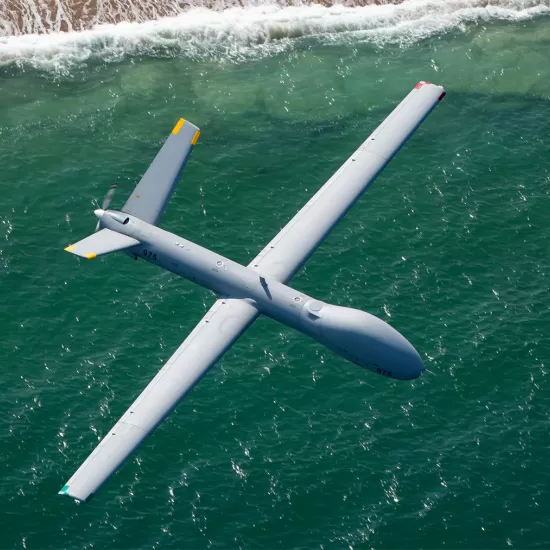
Among the most versatile assets is the Hermes™ family of unmanned aircraft. Platforms such as the Hermes 900™ and Hermes™ 450 – long recognized for endurance and payload capacity – now supply real-time imagery for environmental monitoring, maritime search operations and disaster assessment.
Even compact systems such as Skylark™ – originally designed for tactical units – now deliver important airborne awareness during local incidents. These platforms are no longer confined to military use; they have become important enablers within the civilian domain.
Borders as Stabilizing Forces, Not Just Lines
Modern borders are dynamic ecosystems shaped by migration patterns, smuggling activity, climate-driven movement and regional instability. Managing them effectively requires continuous, multi-layered situational awareness – precisely the domain in which Elbit has operated for decades. Today, border protection relies on integrated infrastructures made up of towers, sensors, electro-optics and networked command environments.
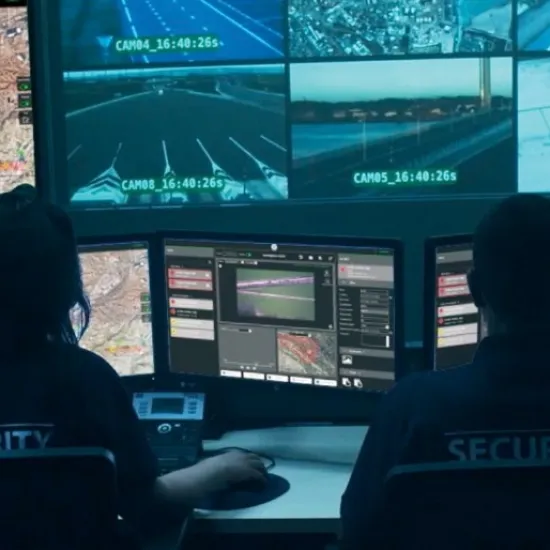
Border management no longer treats the perimeter as a static line but as a dynamic ecosystem under continuous observation. The Torch-X™ Borders C4I solution reflects this shift. It fuses the different layers of border awareness into a single, real-time operational picture. Ground sensors, electro-optical systems, fixed and mobile surveillance assets and radar inputs all converge into one coherent environment that enables operators to detect, classify and interpret emerging activity with exceptional clarity.
The system supports both manned and unmanned platforms and employs automated decision-support tools to prioritize alerts, streamline sensor-to-responder workflows and coordinate units across large and complex terrain.
Training for Crises, Not Just Combat
As threats evolve, so must the ways agencies prepare. Civilian organizations now require simulation environments that accurately mirror the complexity of real-world emergencies. Elbit’s Mission Training Center (MTC) was built for precisely this need. Its full-cycle simulation architecture – from planning through execution to debriefing – helping emergency responders to train for floods, wildfires, mass-casualty incidents and multi-agency coordination in controlled, immersive settings.
This is no longer military training repurposed for civilian use. It is a dedicated approach to strengthening national resilience through rehearsal, data-driven learning and realistic stress adaptation.
The New Science of Civil Readiness
Beyond sensors and networks lies a more unconventional frontier: bio-convergence. Elbit’s work in this emerging field explores how biological insights can improve threat detection, environmental sensing, health monitoring and early-warning systems.
What began as a way to better protect soldiers may eventually support public-health agencies, disaster-response teams and environmental authorities seeking faster and more intelligent methods of identifying risk and emerging health issues.
The world is entering an era in which crises arrive faster, last longer and span every domain. Nations could be better prepared for this era by developing integrated resilience, combining defense-grade intelligence, civilian readiness and a unified operational picture of their environment.