

“The Air Force was surprised”: The new missile revealed during the war with Iran
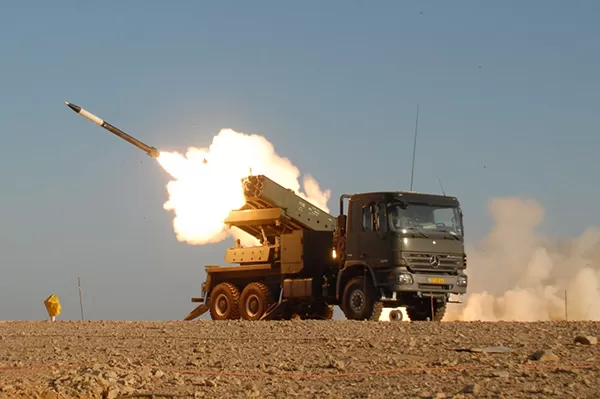
While fighter jets were flying back and forth to Tehran, the artillery’s “Lahav” launchers (PULS) were working overtime: more than 50 “Bar” rockets (EXTRA) were launched at the beginning of Operation “Roaring Lion” toward anti-tank squads, buildings, and Hezbollah targets. The new rocket, which promises a level of accuracy not previously seen, was developed for years behind closed doors at Elbit and has become what the IDF calls “a substitute for the Air Force.” Now, both in the military and in the industry understand: this is only the beginning.
by Eitam Almadon | N12 News
During the first nights of Operation “Roaring Lion,” when Air Force aircraft repeatedly made the long journey to Iran, an entirely different war was taking place along the northern border. After about a day and a half of hesitation, Hezbollah joined the campaign. Israel began striking Beirut and declared a maneuver of its forces up to the “anti-tank line” - about ten kilometers into southern Lebanon. The IDF operated on this front with hundreds of soldiers, but without sufficient support from the Air Force, which during the first 40 days was busy flying back and forth to Tehran.
It can now be revealed that into this operational and strategic vacuum entered the artillery corps’ new “Bar” rocket. While most attention was focused on Air Force strikes in the east, Battalion 334 in Lebanon operated the new missile on an unprecedented scale, recording more than 50 successful launches against Hezbollah targets in the early days of the war. Anti-tank squads, buildings, and enemy infrastructure were identified and struck in real time. In some cases, according to the military, only a few minutes passed from the moment a target was identified until the rocket was already in the air.
“When the Air Force is in Iran, someone is dealing with Lebanon”
Until recently, such a scenario would have sounded almost imaginary. The artillery corps had long been perceived as a force of statistical fire: high volume, less precision. The rockets themselves suffered from a problematic image dating back to the Second Lebanon War, when MLRS cluster rockets were used, leaving behind many unexploded remnants and have not been used since.
More than a decade ago, and even more so following the lessons of Operation Protective Edge in 2014, the IDF understood that it could not continue to rely solely on Air Force aircraft to provide maneuvering forces with the precise fire they needed. The operational need was clear: an independent, precise, fast, and available land-based capability that could strike structures and complex targets in real time—without relying entirely on the Air Force. As an initial response, the “Romach” rocket (ACCULAR) was developed by IMI Systems (now Elbit Systems) and entered service that same year.
However, the real shift in the IDF’s approach to using rockets came only after October 7, when the “Romach” was first used operationally. In the past two and a half years, IDF policy has changed completely: rockets have been used far more frequently and have often replaced airstrikes—whether due to a shortage of available aircraft and bombs, or because of the understanding that a rocket strike can be executed more quickly. The “ACCULAR” was widely used in Gaza and Lebanon, and about a year ago, based on lessons learned from its use, it was replaced by the “Bar” - a much more advanced and significantly more accurate version from the same Elbit rocket family.
In April last year, Battalion 334 carried out the first operational firing of the “Bar” at Hamas targets in the Gaza Strip. Initially, compounds and warehouses were targeted, and later buildings where Nukhba terrorists who participated in the October 7 massacre were located. But in the IDF they say the truly significant operational use came only during Operation “Roaring Lion” - where the understanding matured that the new system is no longer “just another rocket,” but a tool capable of changing the division of labor between the ground forces and the Air Force.
“When the Air Force is dealing with Iran, someone is dealing with Lebanon,” says Lt. Y., operations officer in Battalion 334 of the 282nd Fire Brigade, the only regular rocket battalion in the artillery corps. “That’s exactly what this system brings to the battlefield - precision, speed, accessibility, and ease of operation. You can call it a substitute for the Air Force, you can call it parallel to the Air Force, but in the end this system provides many things others do not.”

Only a few days ago she celebrated her 26th birthday, and she has already served eight years in the battalion. She has seen the rocket array in its previous iterations—the transition to “Romach” , then the shift to the wheeled “Lahav” launcher, and finally the operational integration of the “Bar”. Now, after long months of fighting, she is convinced that something fundamental has changed in the way the IDF employs firepower. “Maneuvering forces don’t want to seize territory without artillery,” she says. “The moment we understood what troubled them and knew how to provide a response with fire - they go into battle differently.”
“For a year and a half they’ve been trying to get their hands on them”
The exact range of the “Bar” is not disclosed, but it is longer than that of the “ACCULAR”, which was around 35 km. Instead of GPS guidance, which is relatively easy to jam, it operates using advanced guidance combined with “Zik” UAVs (Hermes 450), which mark the target for it. If “Romach” provided an average accuracy of about 10 meters, the “Bar” approaches an accuracy of about 5 meters.
“This is a super-precise munition. Relevant both for open areas and for buildings. We neutralize enemy infrastructure, destroy it, eliminate terrorists and senior operatives, and close loops quickly.”
But according to Lt. Y., the real story is not the dry numbers but time. “We also have ‘act now’ targets - the goal is to bring fire as quickly as possible. That’s the nature of the battalion.” The IDF explains that the “Bar” significantly expands the artillery corps’ capabilities and enables it to carry out missions that until now were almost exclusively reserved for the Air Force - or in some cases were not carried out at all.
In one case in the south, Lt. Y. recounts that her company received intelligence on terrorists involved in the October 7 massacre.
“For a year and a half they had been trying to get them, and then one company was able to close the loop within ten minutes.” In another case in the north, an anti-tank squad threatening maneuvering forces in Lebanon was identified. “Within 12 minutes we closed a fire loop on that squad,” she recalls. “The result: nine terrorists eliminated.”
This article was written by Eitam Almadon for N12 News. We received permission to translate it. For the original article in Hebrew, Click here.
Photos and videos by: IDF Spokesperson

